Why Most Businesses Don’t Fail — They Fade: The Hidden Growth Problem
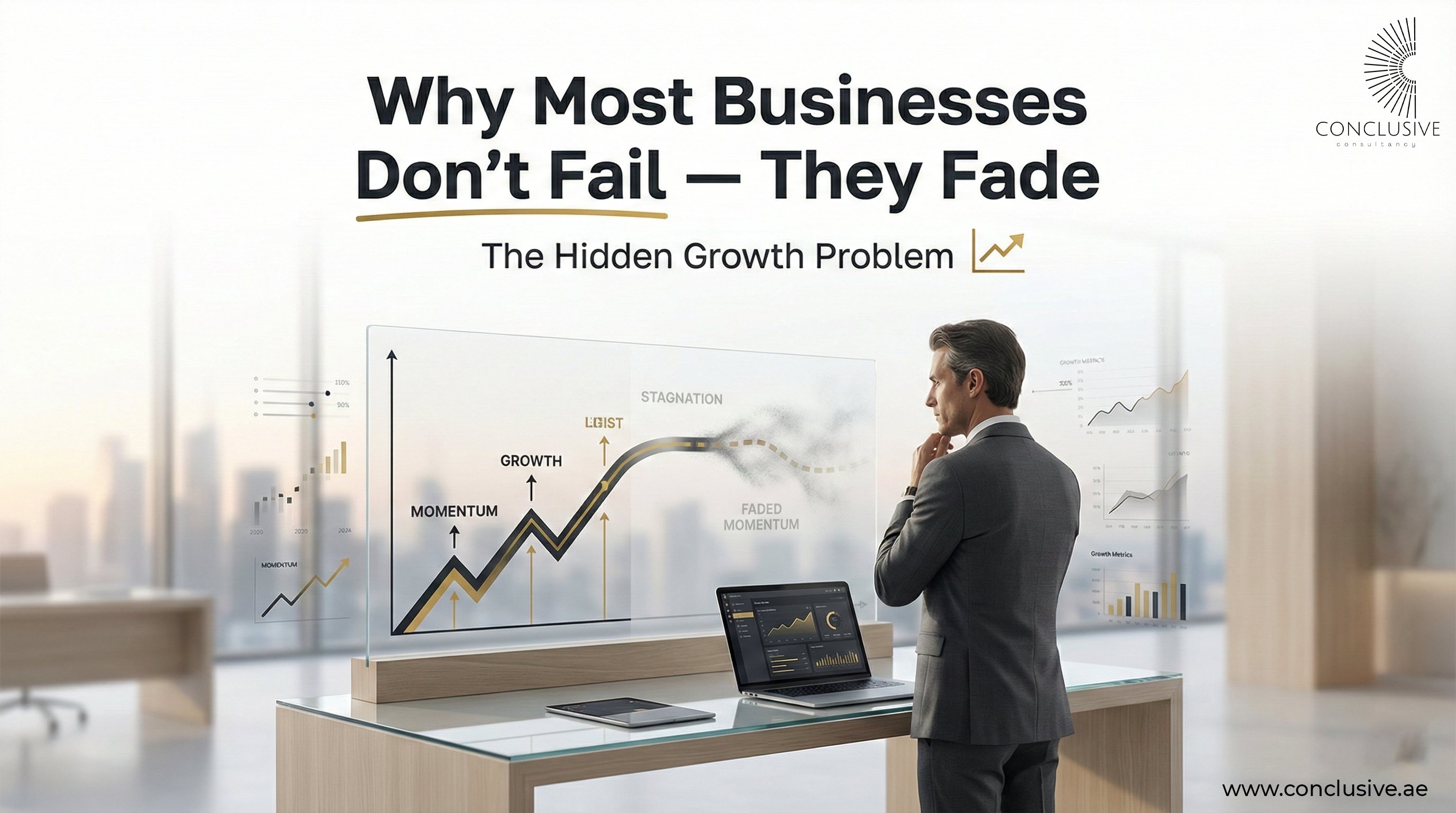
If your business looks the same as it did 3 years ago, your competitors have already won.Most businesses don’t collapse overnight.They don’t make headlines.
They don’t announce shutdowns with dramatic statements.They simply fade.Revenue may stay stable for a while. Teams remain busy. Marketing campaigns run. Social media posts go out. Yet something subtle begins to happen — relevance declines.And in today’s digital economy, relevance is the first thing you lose — not revenue.Welcome to the hidden growth problem.
The Real Reason Businesses Stagnate
In the digital era, stagnation doesn’t look like failure. It looks like comfort.
- The same website for years
- The same service packaging
- The same acquisition channels
- The same internal systems
- The same messaging
Meanwhile, customer behavior evolves rapidly.Over the last few years, we’ve seen a shift toward:
- Mobile-first decision making
- AI-driven personalization
- Instant customer support expectations
- Data-backed purchasing journeys
- Omnichannel brand experiences
Yet many companies are still operating with traditional strategies in a digital-first world.That gap is where stagnation begins.
The Relevance Gap: Traditional Strategy vs Digital Reality
Traditional business strategy was built around:
- Long-term planning cycles
- Linear customer journeys
- Mass marketing campaigns
- Offline brand dominance
Digital reality is different.Today’s growth environment is:
- Real-time and data-driven
- Customer-centric and personalized
- Experience-focused
- Platform-powered
- Constantly evolving
If your strategy hasn’t evolved with your customer, your brand quietly slips behind.And here’s the hard truth:Your competitors don’t need to outperform you immediately.
They only need to out-adapt you.
Why “Doing Marketing” Isn’t Enough
Many businesses respond to slowing growth by “doing more marketing.” More ads.
More posts.
More campaigns.
More budget.But marketing without a digital foundation is like pouring water into a leaking bucket.Marketing generates attention.
Digital transformation captures, converts, and compounds that attention.If your backend systems, customer journey, data infrastructure, and digital experience aren’t optimized, marketing becomes a short-term boost — not a scalable engine.Modern growth requires more than visibility. It requires integration.
- Is your CRM aligned with your marketing funnel?
- Is your website optimized for conversions, not just traffic?
- Are you collecting actionable customer data?
- Is your brand experience consistent across platforms?
- Are your internal processes digitally enabled?
If the answer is “not yet,” you’re not facing a marketing problem.You’re facing a digital maturity problem.
The Rise of Customer-First Digital Ecosystems
The businesses winning today are not just promoting products.
They are building ecosystems.A customer-first digital ecosystem means:
- Seamless website experience
- Smart automation workflows
- Data-driven personalization
- Integrated sales and marketing systems
- Scalable technology architecture
- Clear brand positioning across digital channels
In this model, marketing, sales, technology, and strategy are not separate departments — they are interconnected growth systems.Growth becomes engineered.Not accidental.Not seasonal.Not campaign-dependent.But structured, measurable, and scalable.
Why Businesses Fade Instead of Fail
Let’s address the uncomfortable reality.Most companies don’t disappear because they’re bad.They fade because they stop evolving.
- They underestimate digital acceleration.
- They delay transformation because current revenue feels “safe.”
- They treat digital as a department, not a foundation.
- They invest in tactics instead of long-term capability.
The danger is not immediate loss.The danger is slow irrelevance.And irrelevance compounds quietly — until it shows up in declining leads, lower engagement, shrinking margins, and increased competition.By the time revenue drops significantly, the market has already moved on.
The Shift: From Business-as-Usual to Digital-First Strategy
To prevent fading, businesses must rethink growth at the strategic level.This is where Strategic Consulting and Digital Transformation play a crucial role.Digital transformation isn’t about:
- Redesigning a website
- Running paid ads
- Posting consistently on social media
It’s about redesigning how your business operates, competes, and delivers value in a digital economy.It includes:
- Digital maturity assessment
- Business model optimization
- Technology integration
- Customer journey engineering
- Scalable digital infrastructure
- Performance measurement frameworks
It transforms a reactive business into a future-ready brand.And that shift is no longer optional.It’s fundamental.
Growth Today Is Engineered — Not Accidental
In the past, growth could happen organically.Less competition.
Slower markets.
Longer customer loyalty cycles.Today, growth is intentional.It requires:
- Strategic clarity
- Digital infrastructure
- Customer-first thinking
- Agile execution
- Continuous optimization
The companies that understand this are building systems — not just campaigns.They are creating digital-first foundations that allow them to scale faster, adapt quicker, and outperform competitors consistently.
The Question to Ask Yourself
If your business looks the same as it did three years ago…
- Same positioning
- Same technology
- Same processes
- Same customer journey
Then ask yourself:Are you growing — or just maintaining?Because in the digital era, standing still is the fastest way to fall behind.
What’s Next?
Growth today is no longer accidental — it’s engineered.In our next edition, we’ll break down how Digital Transformation turns stagnant businesses into scalable digital brands — and what practical steps you can take to start the shift.If you’re serious about building a business that doesn’t just survive but evolves, this is a conversation you can’t afford to miss.
